Ryan
Lester.
I study where work and technology are headed, and I use foresight methods to test what comes next.
 RL Perspectives · Houston
How I work
Foresight methods, run as research. Each step produces evidence you can check and a call that can turn out wrong.
- ScanHorizon scanning as data collection. I gather signals from many fields and score each for impact and likelihood, with the source kept.
- Find the driversI separate trends that persist from noise, and state what evidence would show I am wrong.
- Test the linksCross-impact analysis tests which drivers move each other and how strongly.
- Build scenariosA small set of scenarios, each with its assumptions, evidence and the signals that would confirm or break it.
- Pressure-test the decisionStress-test the decision against each scenario. What holds up in all of them is what to do now.
- Test the preferred futureSTILE Transformation is a structured assessment of how ready a target future is. We grade it across five areas: social acceptance, technological capability, infrastructure, legal, and entrepreneurial will and resources. That shows where change can start and where it needs the most work.
Rational Foreclosure
A stochastic reference-point model of when it is rational to stop pursuing an aspiration as the target shifts unpredictably. Behavioral economics, with Gen Z's checked-out relationship to grind culture as the live case. 33 pp. Read on SSRN · Model on GitHub
Regime Boundaries
Task complementarity, physical validation, and the limits of semi-endogenous growth under AI amplification. Where the AI growth story runs out of road, and why. Read on SSRN · On GitHub
Two Sectors, One Airspace
Uses COVID’s traffic collapse as a natural experiment. Commercial and general aviation safety moved differently, so standard accident metrics mislead. 16 pp. Read on SSRN · On GitHub · The essay
The Future of Masculine Social Expectations in the United States, 2040
A semester-long foresight research project: scanning, drivers, scenarios, and field interviews on where American expectations of men are headed.
I spent 22 years in the Navy learning how people actually behave under pressure. Not how the org chart says they should.
My first decade was spent fixing aircraft and teaching the people who would. I taught avionics in Pensacola and built the schoolhouse’s Master Training Specialist academy, which trained 150 instructors. Later I led IM3, the largest division in the aircraft maintenance department aboard USS Ronald Reagan. During Reagan’s 2012 docking availability, I served as a zone manager and managed 98 shipboard jobs across 105 spaces to completion ahead of schedule. For the 2014 availability, I led 29 Sailors through more than 2,000 maintenance actions coordinated with 17 departments, 15 maintenance teams, and 10 outside organizations. I was hand-picked to teach Ship’s Indoc, the orientation course for new crew. As security manager at Naval Hospital Bremerton, I led the hospital’s first wall-to-wall review of security clearances for 1,300 military and civilian staff across the hospital and its three clinics, and delivered base-wide badging with 15 security managers across Naval Base Kitsap.
In 2016 I became a drill instructor at Recruit Training Command, the Navy’s boot camp, and finished as the one training the drill instructors. I ran operations for Battle Stations, the overnight capstone every recruit has to pass, for as many as 352 recruits a night. I proposed and ran the first Great Lakes Chief Leadership Symposium, which brought together more than 500 senior enlisted leaders, including the Master Chief Petty Officer of the Navy. And I contributed to Vanderbilt University’s working group on mental toughness, work that later became part of the Navy’s training pipeline.
When the pandemic threatened the flow of new Sailors, I ran daily operations for the quarantine detachment at Fort McCoy: COVID testing, training, and the health of 40,797 recruits, working with 31 senior enlisted leaders across 109 barracks and five support facilities. The Navy was the only service branch to meet its intake goals that year.
I first joined USS Abraham Lincoln for her 2020 maintenance availability, serving as a zone manager. I worked alongside 12 senior enlisted leaders and coordinated across 20 departments and 24 shipyard shops and external organizations to complete 856 work items. The availability finished early and under budget. After Fort McCoy I returned to sea aboard USS Abraham Lincoln. As quality assurance supervisor, my report card was the Aviation Maintenance Inspection, the inspection every Naval Aviation command undergoes, and in 2021 our score was the highest in the Navy. I was also the Ship’s Damage Control Training Team Coordinator, the only non-engineer in that role at the time. I analyzed training needs, standardized the team’s qualification process, and trained and qualified 210 training team members, running weekly firefighting, flooding, and casualty-response training that prepared a crew of more than 3,000 for certification before deployment.
After the Navy I treated clinic recruiting like an operations problem and filled more than 260 hard-to-staff roles. Less than a year in, I was asked to lead the recruiting team. Now I am in the University of Houston’s foresight program, learning to do formally what I have always done: notice the thing before it has a name.
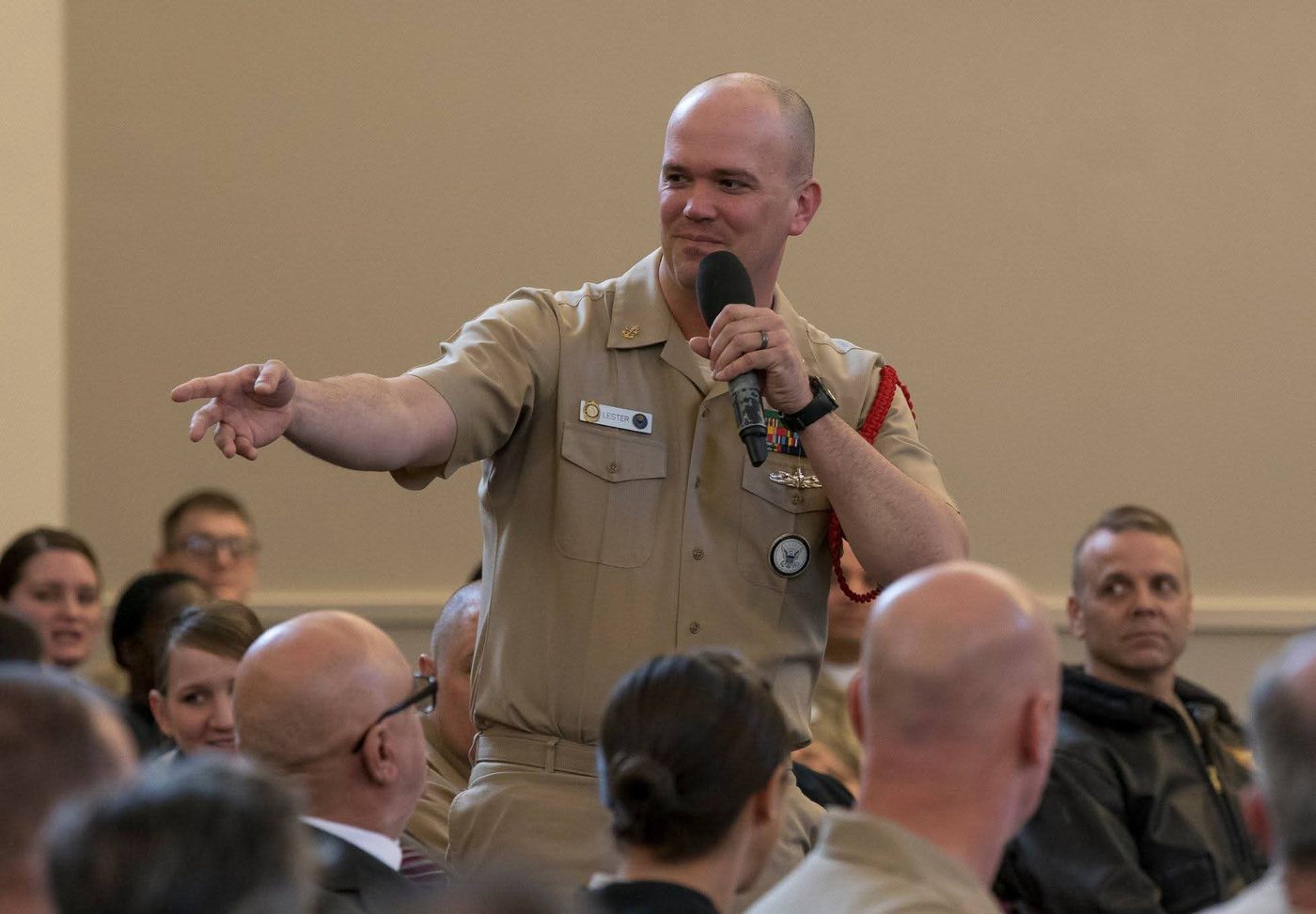
When I first drafted this career-long bio to establish my personal brand, I couldn’t help but notice how much it contained the word “I”. In a world where our value is measured by our personal accomplishments, I suppose I’m good at quickly understanding and playing by those rules. But ultimately, I want to change them.
How I think
What I’m good at: finding the assumptions underneath a decision and testing whether they survive the awkward exception. I trace the downstream effects, ask how good the evidence really is, and keep what I know separate from what I am guessing. I work best where the stakes are real and the answer isn’t obvious yet, and I would rather give you a clear call with its limits stated than a confident one without them.
I am an applied researcher trained in foresight at the University of Houston, the oldest and most respected foresight graduate program in the world. I use its methods as research tools: horizon scanning, STEEP, drivers of change, cross-impact analysis, scenario planning, Causal Layered Analysis and Three Horizons. What I add is a behavioral economics lens of asking what people will actually do, and a research habit of putting a number or a test behind the story, and I state a call I could be wrong about. I publish the papers and the code so the work can be checked.
Where I’m headed
Where I want to take this is public policy, climate impact, city planning and infrastructure, and population health (which is NOT the same thing as public health). I think the 10-minute city is the next evolution in city planning, and I want to help design toward it. Done right, that means lifting up and improving communities without pricing out the people who define them.
The sectors I know best from the inside are operations and logistics, defense, and manufacturing, which is where my naval aviation maintenance background fits. Three aircraft carrier maintenance availabilities also taught me large-scale project coordination, and that experience carries beyond the waterfront. Finally, education rounds out the list, built on years of Navy instruction and curriculum design, plus AI-integration toolkits I built for K-12 and higher ed.
Who I work best with
If you’re a firm/founder whose primary goal is solely to increase your market share, I’m not your guy. My priority is changing the rulebook—using the market, and people that believe they can change it, to create a better future for everyone. The clients I do best with are government agencies, nonprofits, teams and founders who want to see what is coming. I offer observations and recommendations, and what happens after that is your call. If you want to keep going, we can backcast from the future you choose. For work that serves a public or community benefit - whether from an agency, a nonprofit, or a business - I’m open to tailoring the engagement to the mission and the scope. If your project sits outside these sectors, bring it to me anyway. I’m open to applying my research and foresight methods to other fields and working with people who know them from the inside.
Work
with
me.
RL Perspectives is my independent research practice. I take on work that needs someone who will read the data himself and tell you the honest version. The best fit is an agency, team or founder who wants to see what is coming and will act on what the evidence says.
- Applied researchSocial science, public policy, and behavioral-economics research, from question to brief.
- ForesightHorizon scans, driver and cross-impact maps, and scenario sets built around a specific decision.
- STILE TransformationA method for applying this work to design a preferred future, and finding where change can start.
- SpeakingGuest lectures and talks on the future of work, AI adoption, and what the data actually says.